
Wayne County Wanted Records
For wanted records in this county, the Wayne County Sheriff's Office warrant page is the place to start. It's a live, sortable feed. No handpicked fugitive roster here. Entries come and go as warrants are added or cleared. There's no set refresh schedule, so whatever count appears on a given visit reflects that moment only. A live check always beats an old screenshot or a social media post. Shown here is a view of the official Wayne County warrant search interface.
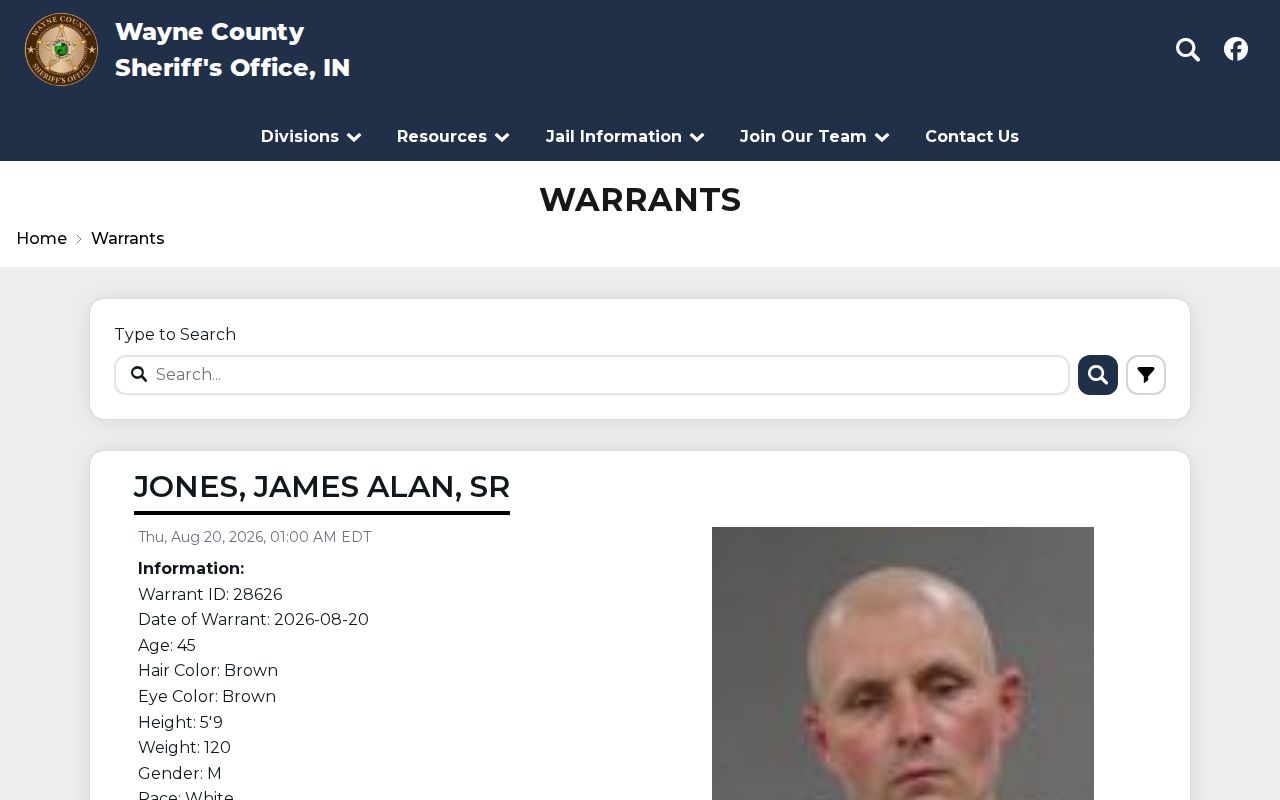
Always run a live check through the sheriff's page. A screenshot only shows how the source looked at one point in time.
Some entries include a photo. Others say no image is available, and that gap doesn't lessen the warrant's force. When a picture does appear, it may be an older booking photo or another form of ID, so it tells you nothing about current custody.
Wanted and jailed are two different statuses. A warrant means a court or law enforcement is looking for someone. It doesn't mean Wayne County Jail holds them right now. After an arrest, the person may appear in the inmate portal. Any case that follows can be tracked through Indiana's MyCase system.
Wayne County Warrant Listing Fields
Every result in the feed offers several data points. These help separate people who share a name. Read the full entry before drawing any conclusion. Don't rely on a face or a name alone. Photos can be dated, and names can belong to more than one person.
| Field | What it means |
|---|---|
| Name and warrant ID | The listed identity and the sheriff's identifier for that warrant record. |
| Warrant date | The date tied to the warrant, not an arrest or conviction date. |
| Age and description | Age, hair, eyes, height, weight, gender, and race may help separate similar names. |
| Charge | The charge associated with the warrant. It can differ from charges later filed in court. |
| Image | An identifying image when available. Some current entries have no image. |
Keep in mind that descriptors shift over time. A listed age may follow the feed's own date logic rather than the person's current age. Before acting on anything, confirm the warrant with the sheriff or the court. Treat a public listing as a starting point for an official check, not as grounds for private action.
Search Wayne County Wanted Entries
Let the current feed drive every search. It reflects the sheriff's present system better than the older county form, and it carries the fields needed for careful matching.
- Open the sheriff's warrant page and search the person's full name. Sort or narrow the displayed results when needed.
- Compare the warrant ID and date, then check the physical description and charge. Do not rely on the image alone.
- If the person may have been arrested, use the Wayne County booking and inmate search. A warrant entry and a jail record answer different questions.
- Check the court record for later filings and disposition. Filed charges can differ from the charge shown with the warrant.
- Confirm current status through the sheriff or court when the answer will guide a real decision.
Online results go stale fast. Someone may have been arrested days ago. Yet the entry still sits there. An empty search proves just as little, since no online tool can promise that no warrant exists anywhere. Misspelled names, slow system updates, or a warrant from a different court can all hide a hit.
Check a Wayne County Warrant
Searching one specific name? You have several official routes. The broad feed is a good first screen. For confirmation, though, the sheriff's office, the issuing court, or your own lawyer are the channels that matter, especially if you want a warrant resolved safely. The county's older lookup still works too, though its own page notes a 2016 revision.
- Search the current sheriff feed by name and compare the details rather than accepting the first match.
- If necessary, try the legacy county form, which permits date or range, name, street, city, and state searches. Treat it as a dated fallback.
- Contact the sheriff, the relevant court, or an attorney to confirm what is active and identify the lawful next step.
- Resolve the matter through counsel, the court, or a sheriff-directed process. Do not use web results to avoid contact or enforcement.
That legacy form earns its keep when a name search turns muddy. Its broader fields can separate people with similar names. The form's age is a real drawback, though. An old online result is never the last word. Trust the current answer from the responsible office instead.
Wayne County Warrant Types
A feed entry may hint at what kind of warrant sits behind it. Its dates and case details offer clues. Only the exact court record controls, though. Knowing the type matters. That is why a complete search always circles back to the court.
| Record type | Practical meaning |
|---|---|
| Arrest warrant | A judge authorizes an arrest in connection with an alleged offense. |
| Bench warrant | A court directs an arrest after a missed appearance or failure to follow a court order. |
| Wanted highlight | A selective public post drawing attention to a warrant. It is not a different kind of legal order. |
| Custody record | A jail entry showing that a person was booked or held. It is not itself a warrant. |
When bond appears after a booking, treat it as a custody or release condition, not a sentence. The court record holds the outcome.
Wayne County Warrant Wednesday
No standing most-wanted list comes out of Wayne County. Instead, the sheriff's office runs Warrant Wednesday, a highlight series that appears through sheriff news and social channels. A typical post shows a photo, lists a charge, and asks the public for tips. Keep expectations modest here. These are snapshots, not a live warrant database. A person highlighted one week may already be arrested by the time you see the card, since the sheriff has published later updates noting such arrests and the older posts stay online. That's why the current warrant feed should always be your starting point, with the status confirmed before anything else.
Does Warrant Wednesday cover every Wayne County warrant? No. The weekly feature is selective, while the searchable feed is broad. Someone can have a published warrant entry without ever appearing in a highlight.
Wayne County App and Tips
The Wayne County Sheriff's Office puts its main services on a single mobile app. Users can view warrant images, look up inmates, read news and media reports, and send anonymous tips. Download it from the sheriff's official app share page. Keep one thing in mind. The app is a doorway to official services, not a bigger or separate warrant database than the ones the county already publishes.
Warrant Wednesday posts push tips toward dispatch or the anonymous channels on the website and app. No official reward is on offer, so don't expect payment for a tip. Share specific, recent facts. Trained officers will take it from there.
200 E Main Street
Richmond, IN 47374
Tips and dispatch: 765-973-9355
Administration: 765-973-9393, option 2
Online: Anonymous tip form
The app and the tip form are not for emergencies. If someone is in immediate danger, call 911 right away. For everyday warrant questions, take a different route. Dispatch or the court can tell you whether a record is current or just an old post.
After a Wayne County Arrest
Once an arrest happens, a different source answers each new question. The warrant feed shows whether officers had authority to seek someone. The jail portal shows who is in county custody. MyCase shows what prosecutors filed and what the court later ordered. These are separate records. Treat them that way.
Start with the Wayne County Jail roster to check custody, past or present. Then search MyCase by party name or case number and filter for Wayne County. The case history may list filed counts, hearings, amendments, orders, and a final outcome. Some sealed or confidential matters stay hidden from view.
Careful matching also guards against mistaken identity. Compare the name, warrant date, arresting agency, alleged offense, arrest date, and case number when one becomes available. If sources conflict, the responsible sheriff or court should resolve the status.
A transfer adds another possible status. Someone no longer in the county roster may have been released, moved to another custodian, or sent to state correctional custody after the case progressed. The Indiana Department of Correction offender search applies to state custody or supervision, not to an open Wayne warrant or a recent county booking. Use it only when that stage fits the facts. Social posts should also be checked for later updates because an arrest notice can change the meaning of an older wanted appeal.
When the online feed is down, keep the official address and use the sheriff's contact route or app. Do not replace a temporary outage with an unofficial result. A narrow question to dispatch or the court is safer than guessing from cached text, copied photographs, or a publisher page that does not show when its data last changed.
The court path also explains why a warrant allegation and a later docket may not use the same words. Police information can describe the basis for seeking a person, while the prosecutor decides what to file. A judge may then issue orders, change release terms, or close the case. Search MyCase by party name, citation number, or case number, select Wayne County, and read the newest entries in order. Some sealed, confidential, or non-electronic material will not be visible. An absent public docket is therefore not a reason to publish a guess.
Keep custody alerts separate as well. Indiana SAVIN can notify registered users about placement, release, transfer, and other custody changes across county and state systems. It does not verify the merits of a warrant and does not supply the court outcome. Its value begins after a custody event, when repeated manual roster checks would otherwise be needed. The warrant feed, jail portal, SAVIN, and MyCase each answer a distinct question.